
Abstract
Clam gardens are an Indigenous mariculture (marine farming) practice developed by Indigenous peoples in the Pacific Northwest and British Columbia to increase shellfish productivity through long-term care of their shores. This literature review paper examines how clam gardens function not only as ecological systems but also as cultural and social spaces that support food sovereignty and the transmission of knowledge across generations. This review brings together archaeological research, ecological studies, and Indigenous-led reports to understand how clam gardens alter water flow, sediment retention, and shoreline chemistry, thereby supporting faster-growing, more resilient clam populations. It also highlights how current restoration projects are working to improve community involvement and intergenerational learning. While scientific research clearly shows the ecological benefits of clam gardens, there is limited research on their historical and cultural significance and on how they are affected by climate change.
Introduction
During low tide, the shoreline is quiet except for the sound of stones shifting underfoot. Elders and children move together across the exposed beach, lifting rocks into place — one by one, stone by stone. Soon enough, the beach lies clean and flattened, its smooth terrace holding the quiet promise of harvest: clam garden. Moments like these reflect more than a method of food production; they reveal a system in which ecological engineering, cultural knowledge, and community responsibility become one. This literature review examines traditional clam gardening practices in the Pacific Northwest and British Columbia to understand how these systems have increased clam productivity, supported food sovereignty, and reinforced cultural continuity. These clam gardens are intertidal beaches that Indigenous peoples have modified to promote clam growth. At a time when climate change, ocean acidification, and declining shellfish populations threaten coastal food systems, clam gardens offer a unique model for restorative aquaculture that can sustain ecological stewardship. Although there is growing recognition of clam gardens’ ecological benefits, a significant gap remains in understanding. There is limited documentation of the cultural practices that once supported clam gardening, including how knowledge was taught and shared. Moreover, few studies examine how climate change may affect clam garden systems. Research is also unevenly distributed geographically, with relatively little work focused specifically on Swinomish clam gardens despite their long history of stewardship.
Methods
This paper is a literature review that primarily draws on published secondary sources to examine Indigenous clam gardening practices. Sources for this paper were identified through academic databases, including Google Scholar, JSTOR, and Web of Science, using search terms such as clam gardens, Indigenous mariculture, Coast Salish shellfish, traditional ecological knowledge, and clam garden restoration. The initial intent was to focus on the Swinomish Tribe and their role in creating and disseminating knowledge about clam gardens. However, one of the main challenges encountered was the relative scarcity of scientific studies focused solely on Swinomish clam gardens compared to other research conducted in British Columbia. As a result, this review integrates ecological studies of clam gardens from other regions with Swinomish-led restoration reports and other tribal publications. It also intentionally reflects a balance between peer-reviewed scientific research and community-based resources. This is because understanding clam gardens as living systems requires engaging not only with ecological data, but also with the knowledge holders of the Indigenous communities who are helping to rebuild these areas.
This review is informed by Indigenous-led research, a research approach in which Indigenous communities define the questions, lead the process, and control how knowledge about their lands, cultures, and environments is produced and used. The primary purpose of these research efforts is to help restore, improve, and empower Indigenous peoples and their environments. It can also strengthen the connection between Indigenous and non-Indigenous knowledge. Non-Indigenous-led research, on the other hand, may stem from academic curiosity or other factors, rather than a desire to help or improve Indigenous communities, causing the research to focus on Indigenous tribes but not be made to benefit them.
During the research process, I found the Clam Garden Network, an Indigenous-led clam garden research community, to be a key resource for clam garden-related Indigenous-led research. Rather than serving as a single source, this network is a hub that connects Indigenous knowledge holders, researchers, restoration practitioners, and educators engaged in clam garden knowledge and revitalization. By drawing on the Clam Garden Network’s affiliated researchers, including Hwsyun’yun Skye Augustine, Dana Lepofsky, Ala̱g̱a̱mił Nicole Norris, among many others, I was able to find additional resources relating to clam gardens for the literature review.
Background
The Swinomish Indian Tribal Community has lived on the northwest coast of Washington, maintaining a deep relationship with the intertidal zone that has supported the development of clam gardens. Archaeological and ethnographic research shows that such gardens were constructed as early as 3,500 years ago by Northwest Coast peoples, including the ancestors of the Swinomish, and were key to food security, cultural identity, and ecosystem stewardship (“Swinomish Clam Garden,” 2023). This was not the only community to engage in the construction of clam gardens as an important source of food and sovereignty. Other groups included W̱SÁNEĆ Nation, the Hul’q’umi’num Nations, and more (Council, 2020).
Colonial expansion by American settlers in the 18th and 19th centuries, however, dramatically disrupted indigenous lifeways. The 1855 Treaty of Point Elliott, for example, formally ceded Swinomish lands to the United States while establishing a reservation, yet the loss of access to coastlines combined with forced assimilation and the banning of cultural and spiritual practices led to the gradual halting of clam‑garden construction and maintenance (Larson, 2023; sankofaimpact, 2023). Forced assimilation policies, the seizure of Swinomish lands, and shoreline development displaced tribal caretakers and barred them from traditional harvesting sites, effectively breaking the transmission of marine‑resource knowledge. While each community discussed in this paper has its own distinct history, the experience of settler colonialism and land occupation was shared across Indigenous communities from the Pacific Northwest to British Columbia. The loss of access to clam‑garden sites curtailed the practice of selective harvesting, sediment aeration, and wall-building that had sustained clam populations for generations. Contemporary efforts to revive clam gardening now explicitly blend Indigenous ecological knowledge with scientific knowledge, acknowledging that colonialism erased much of the oral and practical expertise that once guided sustainable mariculture.
How Clam Gardens Are Made
Construction of indigenous clam gardens begins with carefully placing a rock wall at the lowest intertidal zone. By stacking boulders, Indigenous families created a semicontinuous barrier that will trap sediments deposited by waves and tides (Cox et al., 2024). The walled beach will eventually form a flattened terrace, much shallower than the naturally steepened beach slopes, as shown in Figure 1(a-d). Research has demonstrated that this method of structural mariculture improves clam yield. A study on Quadra Island in British Columbia found that Indigenous peoples constructed clam gardens along about 35% of the shoreline, creating 112,979 m² of flattened beach terrace, roughly the size of 20 football fields, and that “about 35% of the area of clam habitat in clam gardens was constructed de novo on bedrock shelves and rocky slopes where no clam habitat existed previously” (Lepofsky et al., 2020, p. 248). Through meticulous planning, Indigenous people created a microecosystem, a self-contained environmental system with its own physical and biological conditions, that transformed unproductive shorelines into highly productive clam habitats.
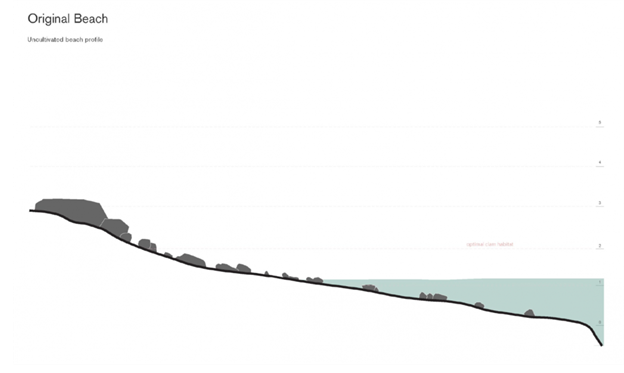
(a) Natural intertidal beach before modification
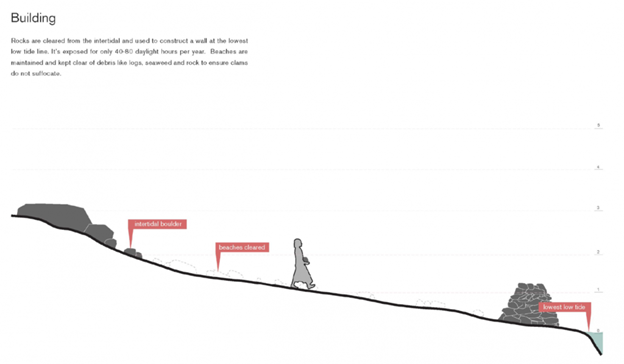
(b) Indigenous stewards construct a rock wall at the lowest intertidal zone.
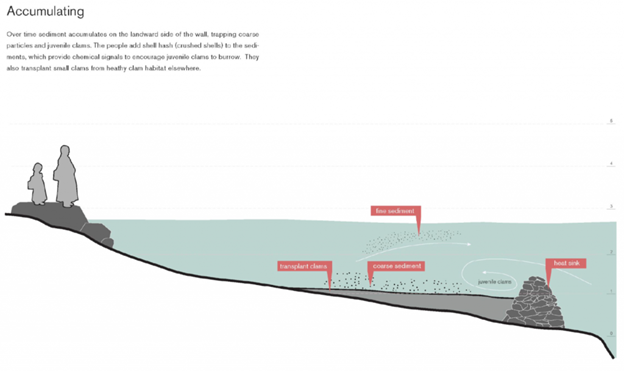
(c) Over time, waves and tides deposit sand and shell behind the wall, forming a flattened terrace.
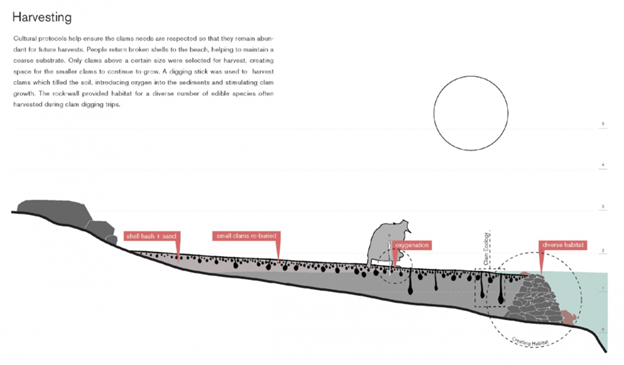
(d) The terrace is maintained through traditional stewardship practices, including sediment turning, shell addition, and sustainable clam harvesting.
How Clam Gardens Change The Ecosystem
The creation of clam gardens not only creates a larger space for clams to grow but also a microenvironment more suitable for their growth, resulting in clams that grow faster and larger, with thicker shells and more nutrient-dense, meatier tissue that supports both ecosystem health and reliable food harvests. One factor that makes the clam garden more suitable for growth is the hydrodynamics created by the walled area, which blocks waves. In a 2024 study, marine and estuarine scientist Maia Hefferman examined the water flow of a walled beach compared to an unwalled beach using an Acoustic Doppler Current Profiler (a device that uses sound waves to measure the speed and direction of moving water). Hefferman discovered that the residence time of the water (the amount of time water remains pooled over the beach) in a clam garden is double what it is in an unwalled beach. This increased residence time means that nutrient-rich water stays in the clam garden longer, enhancing feeding conditions and supporting healthier, faster-growing clams. She further learned that the decrease in water flow will also reduce bed friction velocity (the stirring of sediments or other particles) and vertical shear (the change in velocity with depth) (Heffernan, 2025). This ultimately reduces the number of clam larvae being washed away, since strong currents can easily transport them. Furthermore, it will keep nutrients available in the microecosystem longer, which eventually leads to a larger overall clam biomass, supporting greater food availability for people.
A report by marine ecologist Courtney Greiner, described by Northwest Treaty Tribes (Walker, 2022), contributes to this research by explaining how the rock wall filters fine sediments out to the sea while keeping the nutrients in the walled area, which the clams then utilize. In her study, Greiner described how the accumulation of decomposing shells on the beach will ultimately raise the pH and aragonite saturation of the beaches, creating a microclimate that has less ocean acidification and higher amounts of calcium carbonate for clams to use in building their shells than in an unwalled beach setting (Walker, 2022). This increased availability of carbonate is crucial because clams require it to form strong, resilient shells. In higher pH, calcium-rich environments, clams grow faster, experience lower mortality, and develop sturdier shells that better protect them from predators and other environmental stressors. As a result, stronger shells mean fewer clams are lost to predators, leaving more clams available for sustained human harvest.
As a result of the microclimate formed through the construction of clam gardens, clam populations can be bolstered. In 2011, biologist Amy Groesbeck showed that the clam biomass density between walled and unwalled beaches differed substantially by conducting field surveys in both areas and an in situ transplant experiment in which juvenile Littleneck clams were placed in mesh bags across tidal heights, then assessed for growth and survivorship. They concluded that clam gardens contained four times as many butter clams and over twice as many littleneck clams relative to non-walled beaches (Groesbeck et al., 2014). In another study, Lepofsky et al. (2020) explained how clam gardens increase taxonomic diversity in the terraced area by increasing sediment and shell hashing. In other words, by engineering the shoreline, deep-rooted Indigenous mariculture practices increased the abundance and ecological diversity of nearshore communities, making these environments more resilient and productive than natural, unwalled beaches.
Restoration Efforts
For Coast Salish communities, clam gardens were never just ecological structures; they were also social, educational, and cultural spaces. They fostered intergenerational instruction and supported food sovereignty. Knowledge of clam mariculture was passed from elders to youth through stories, songs, and dances, and “construction and harvest activities were important family events in which proper techniques were learned intergenerationally” (Ward, 2018). Management was often organized by kinship: some gardens were controlled by “specific families and…only families of high status,” while others were communal and open to everyone (Ward, 2018). It’s important to note that colonial disruptions, such as land privatization and cultural suppression, have created gaps in knowledge transmission. Today, revitalization efforts aim to restore both the physical structures and the cultural pathways through which this expertise historically flowed.
One example of these clam garden revitalization efforts is taking place in the Kukutali Preserve, a coastal site in Washington State. In a 2022 article, Northwest Treaty Tribes, a tribal treaty-rights communications initiative, described how the Swinomish Tribe built a 200-foot-long clam garden along their reservation in hopes that it would “offer a social and multigenerational experience” and that “elders will pass down teachings to young ones”(Walker, 2022). This project shows that restoration is not just about repairing ecological structures, but also about rebuilding the cultural systems of teaching, kinship, and responsibility that sustained clam gardens for generations. In 2019, Swinomish Senator Alana Quintasket described how the process of creating clam gardens itself strengthens their community: “It’s a way of community building and bringing the people together and having a purpose, because when you’re out there working, everybody has a role” (Walker, 2022). Senator Quintasket’s explanation highlights the social importance of creating these clam gardens rather than an ecological one.
Beyond Washington State, similar clam garden restoration efforts in British Columbia emphasize the role of revitalization in reclaiming Indigenous knowledge, language, and cultural practices. Starting in 2014, the Clam Restoration Project spent five years restoring clam gardens in W̱SÁNEĆ territory in British Columbia, Canada (Council, 2020). Not only were they able to restore two clam gardens, but the project also aimed to reclaim W̱SÁNEĆ knowledge, practices and culture related to clam gardens and their inhabitants, including the “ȽÁU,₭EM/mussels, and ṮEX̱ṮEX̱/oysters, SQȽÁ ̧I ̧,/ittleneck clams, S’OX̱E/butter clams, ŚW̱ AAM/horse clam and ḴEXÁLS/digging clams”. These clam garden restoration efforts can transform academic knowledge production by changing research from an extractive study of Indigenous pasts toward collaborative, Indigenous-led inquiry that generates ecological data, cultural knowledge, and policy-relevant evidence for sustainable coastal governance.
Climate Change
While climate change is often discussed in terms of ecological impacts, it is also important to consider its harms to public health and Indigenous traditions. In a report on the Swinomish Tribal Community on bioaccumulative toxins in Native American shellfish, it was described that “the primary risk drivers were PCBs, arsenic, and dioxins/-furans…” and that “Risks from eating 100g (3.5 ounces) portions of each species daily for life (for a total of 300 grams per day, a consumption rate reflective of current Swinomish practices) are in the range of concern…” (“Swinomish Tribal Community’s Bioaccumulative Toxics,” 2006). Climate change can often lead to more intense rainfall and flooding, leading to runoff, which may transport toxins such as PCBs or arsenic from urban areas or contaminated soils into the ocean, where the clams filter feed. This clearly demonstrates how the bioaccumulation of certain toxins in the tissues of clams harvested from clam gardens is directly harming and risking the health of people who often rely on seafood as part of their traditional subsistence diet.
While toxic contamination is an immediate health risk, climate change also introduces a longer-term threat that affects not only shellfish survival but the indigenous traditions built around harvesting them. Courtney Greiner, a marine ecologist with the Swinomish Tribe, said “the [tribal] community is concerned, not only about the future loss of traditional harvest sites from sea level rise and impacts to the health of shellfish due to the changing water conditions, she says, but also the subsequent loss in intergenerational knowledge sharing, food security, and identity” (Burch, 2022). This highlights how climate change can go beyond just environmental damage, and also lose the everyday experiences where knowledge is passed down between generations. Over time, that weakens cultural traditions and food systems that communities depend on, not just for survival but for maintaining identity.
Conclusion
Clam gardens are effective because they combine ecological engineering with Indigenous knowledge, and restoring them today requires rebuilding both the physical structures and the cultural practices that sustained them. Much of the existing research goes into the physical and biological factors underlying clam garden success, including sediment retention, reduced wave energy, and improved growing conditions for shellfish. However, the literature is uneven, with far more scientific work focused on sites in British Columbia than on Swinomish clam gardens specifically, making it difficult to apply some findings directly to Swinomish contexts. Additionally, while many sources briefly note that clam-gardening knowledge was passed down through stories, songs, and dances, they rarely explain what those practices actually looked like or how they taught ecological care, leaving a knowledge gap. Future research should move beyond rebuilding physical structures and instead work directly with Swinomish community members to document how clam-gardening knowledge has been shared, which stories or songs have carried meaning, and how those teachings can help with restoration today.
References
- Clam Gardens – UBC Coastal Adaptation Lab. (n.d.). Retrieved March 6, 2026, from https://blogs.ubc.ca/coastaladaptationlab/clam-gardens/
- Council, W. L. (2020, March 10). The Clam Garden Restoration Project. W̱SÁNEĆ Leadership Council. https://wsanec.com/the-clam-garden-restoration-project/
- Cox, K. D., Davies, H. L., Millard-Martin, B., Black, M., Hessing-Lewis, M., Smith, N. F., Juanes, F., & Dudas, S. E. (2024). Ancestral and contemporary intertidal mariculture practices support marine biodiversity in the northeast Pacific. Communications Earth & Environment, 5(1), 351. https://doi.org/10.1038/s43247-024-01515-3
- Groesbeck, A. S., Rowell, K., Lepofsky, D., & Salomon, A. K. (2014). Ancient clam gardens increased shellfish production: Adaptive strategies from the past can inform food security today. PloS One, 9(3), e91235.
- Heffernan, M. (2025). Hydrodynamics and residence time in a newly constructed clam garden. WWU Graduate School Collection. https://cedar.wwu.edu/wwuet/1440
- Larson, S. (2023, January 20). Restoring tradition, place and connection through a clam garden. Washington Sea Grant. https://wsg.washington.edu/restoring-tradition-place-and-connection-through-a-clam-garden/
- Lepofsky, D., Toniello, G., Earnshaw, J., Roberts, C., Wilson, L., Rowell, K., & Holmes, K. (2020). Ancient Anthropogenic Clam Gardens of the Northwest Coast Expand Clam Habitat. Ecosystems, 24(2), 248–260. https://doi.org/10.1007/s10021-020-00515-6
- sankofaimpact. (2023, November 24). The Treaty of Point Elliott. Sankofa Impact. https://sankofaimpact.org/the-treaty-of-point-elliott/
- Swinomish clam garden bolsters littleneck clam populations. (2023, January 14). The Fish Site. https://thefishsite.com/articles/swinomish-clam-garden-bolsters-littleneck-clam-populations
- Swinomish Tribal Community’s Bioaccumulative Toxics in Native American Shellfish project: 2002-2006. (2006, November 30). Retrieved January 30, 2026, from https://www.swinomish-nsn.gov/media/591
- Walker, R. (2022, January 28). Clam garden will bring history full circle at Kukutali. Northwest Treaty Tribes. https://nwtreatytribes.org/clam-garden-will-bring-history-full-circle-at-kukutali/