
An Interdisciplinary Literature Review Exploring How Indigenous Mariculture Practices Can Restore Ecosystems and Strengthen Communities (2026 Mar)
By Olivia Chiu
Founder, Oceancare Alliance | Independent Researcher
Clam gardens are an Indigenous mariculture practice developed by peoples of the Pacific Northwest and British Columbia to increase shellfish productivity through long-term care of their shores. This research examines how clam gardens function not only as ecological systems but also as cultural and social spaces that support food sovereignty and the transmission of knowledge across generations.
By bringing together archaeological research, ecological studies, and Indigenous-led reports, this review explores how clam gardens alter water flow, sediment retention, and shoreline chemistry—while also highlighting critical gaps in our understanding, particularly around climate change impacts and the cultural practices of the Swinomish people.
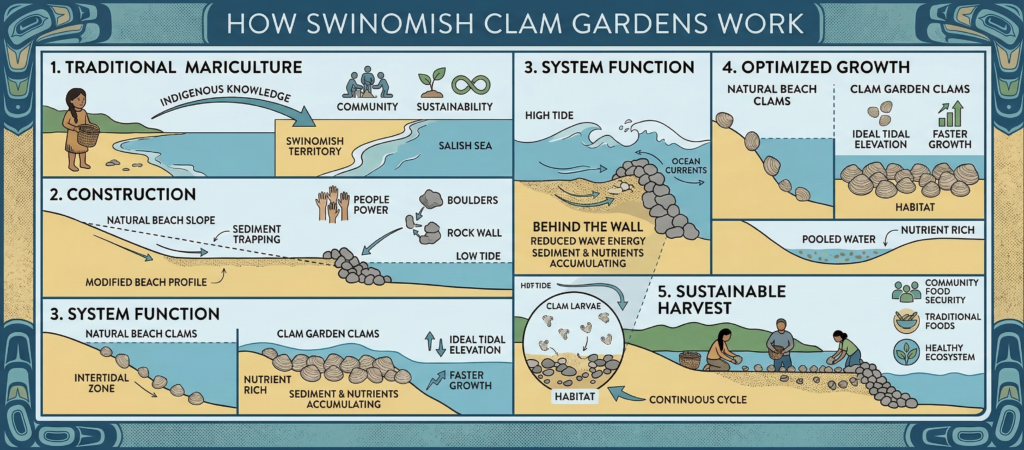
Indigenous communities place rock walls at the lowest tide line. Over time, sediment accumulates behind the wall, creating a flattened terrace at the optimal tidal height for clams. The rock wall also increases water residence time, retains nutrients, and buffers against ocean acidification.
By bringing together archaeological research, ecological studies, and Indigenous-led reports, this review explores how clam gardens alter water flow, sediment retention, and shoreline chemistry—while also highlighting critical gaps in our understanding, particularly around climate change impacts and the cultural practices of the Swinomish people.
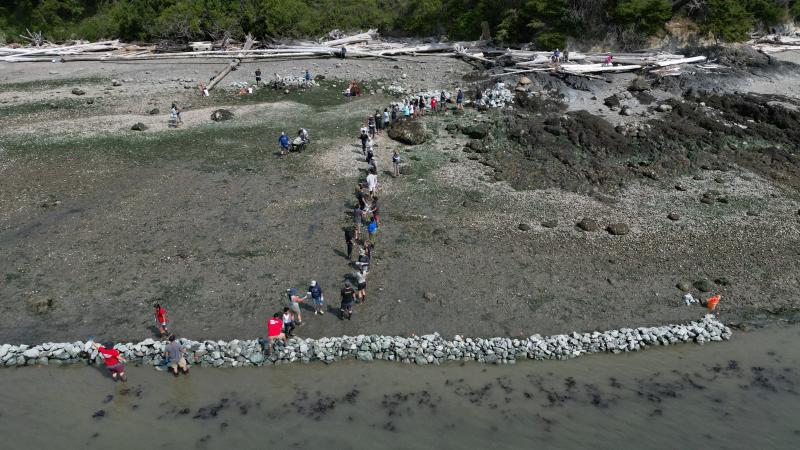
🐚 Swinomish Clam Garden RestorationCommunity members work together to place rocks at the low tide line, reviving an ancient mariculture practice that their ancestors developed over 3,500 years ago. The rock walls trap sediment and create ideal growing conditions for clams.
Clam gardens work through elegant engineering: a rock wall placed at the lowest intertidal zone traps sediment from waves and tides, eventually forming a flattened terrace. But the magic is in the details.
🌊 Hydrodynamics: Research by marine scientist Maia Heffernan (2025) found that water residence time in clam gardens is double that of unwalled beaches. This keeps nutrient-rich water available longer and prevents clam larvae from being washed away.
The rock wall also filters fine sediments while retaining nutrients. As shells accumulate and decompose, they raise the pH and aragonite saturation of the beach—creating a microclimate with less ocean acidification and more calcium carbonate for shell-building.
📊 The Numbers: Biologist Amy Groesbeck’s study found clam gardens contained 4x as many butter clams and 2x as many littleneck clams compared to non-walled beaches (Groesbeck et al., 2014).
The Swinomish Indian Tribal Community has lived on the northwest coast of Washington for millennia, maintaining a deep relationship with the intertidal zone. Archaeological research shows clam gardens were constructed as early as 3,500 years ago by Northwest Coast peoples.
Coast Salish peoples develop sophisticated clam gardening practices, passed down through stories, songs, and dances.
The Treaty of Point Elliott formally cedes Swinomish lands to the United States, reserving a reservation but restricting access to traditional coastlines.
Forced assimilation policies, land seizure, and shoreline development displace tribal caretakers, breaking the transmission of marine-resource knowledge.
W̱SÁNEĆ Clam Garden Restoration Project in British Columbia restores two clam gardens and begins reclaiming traditional knowledge.
Swinomish Tribe builds a 200-foot-long clam garden at Kukutali Preserve—the first modern clam garden in the United States.
Contemporary efforts to revive clam gardening explicitly blend Indigenous ecological knowledge with scientific knowledge, acknowledging that colonialism erased much of the oral and practical expertise that once guided sustainable mariculture.
For Coast Salish communities, clam gardens were never just ecological structures—they were social, educational, and cultural spaces that fostered intergenerational learning and supported food sovereignty.
It's a way of community building and bringing the people together and having a purpose, because when you're out there working, everybody has a role.
— Senator Alana Quintasket, Swinomish Tribe (2019)
Knowledge of clam mariculture was passed from elders to youth through stories, songs, and dances. Management was often organized by kinship: some gardens were controlled by specific families of high status, while others were communal and open to everyone.
🐚 W̱SÁNEĆ Language Revival: Restoration projects work to reclaim not just physical gardens, but traditional vocabulary—including names for mussels (ȽÁU,₭EM), oysters (ṮEX̱ṮEX̱), littleneck clams (SQȽÁ̧I̧), butter clams (S’OX̱E), horse clams (ŚW̱AAM), and digging clams (ḴEXÁLS).
Today’s restoration efforts aim to restore both the physical structures and the cultural pathways through which this expertise historically flowed—transforming research from extractive study toward collaborative, Indigenous-led inquiry.
Climate change threatens clam gardens on two fronts: ecological and cultural.
🧪 Toxin Bioaccumulation: A Swinomish Tribal Community report found that PCBs, arsenic, and dioxins/furans are primary health risks in harvested shellfish. Increased rainfall and flooding from climate change can transport these toxins from urban areas into the ocean, where filter-feeding clams accumulate them in their tissues.
The community is concerned not only about the future loss of traditional harvest sites from sea level rise and impacts to the health of shellfish...but also the subsequent loss in intergenerational knowledge sharing, food security, and identity.
— Courtney Greiner, Marine Ecologist, Swinomish Tribe
Lorem ipsum dolor sit amet, consectetur adipiscing elit. Ut elit tellus, luctus nec ullamcorper mattis, pulvinar dapibus leo.
This literature review draws on academic databases (Google Scholar, JSTOR, Web of Science), tribal publications, and Indigenous-led research communities—particularly the Clam Garden Network, which connects knowledge holders, researchers, restoration practitioners, and educators.
🌱 Indigenous-Led Research: This review intentionally reflects a balance between peer-reviewed scientific research and community-based resources. Understanding clam gardens as living systems requires engaging not only with ecological data, but also with the knowledge holders of Indigenous communities who are helping to rebuild these areas.
Key findings about research gaps:
Future research should: Work directly with Swinomish community members to document how clam-gardening knowledge has been shared, which stories or songs have carried meaning, and how those teachings can support restoration today.
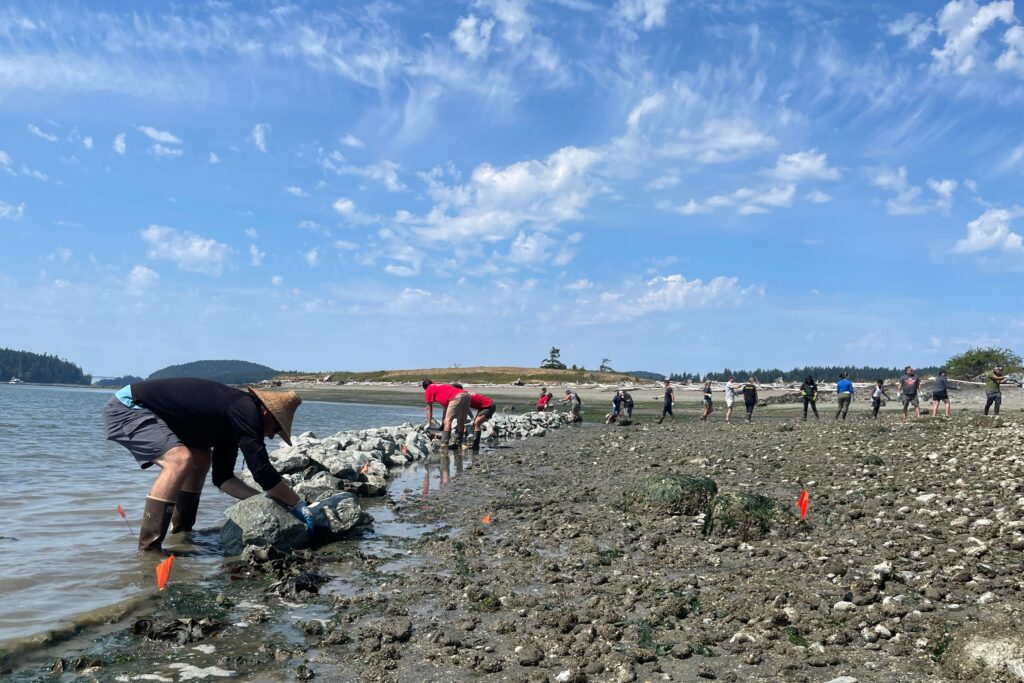
🤝 Community-Driven RestorationClam garden restoration brings together elders, youth, and community members in shared purpose. As Swinomish Senator Alana Quintasket explains: “It’s a way of community building and bringing the people together…when you’re out there working, everybody has a role.”
Clam gardens represent a powerful model for sustainable aquaculture—one that combines ecological engineering with cultural knowledge. Understanding these systems isn’t just about science; it’s about honoring Indigenous stewardship and building resilient coastal communities for the future.
Signup our newsletter to get update information, news & insight
© 2025 Washington Oceancare Alliance is a 501(c)(3) Organization
EIN #99-4324155 · All rights reserved.